
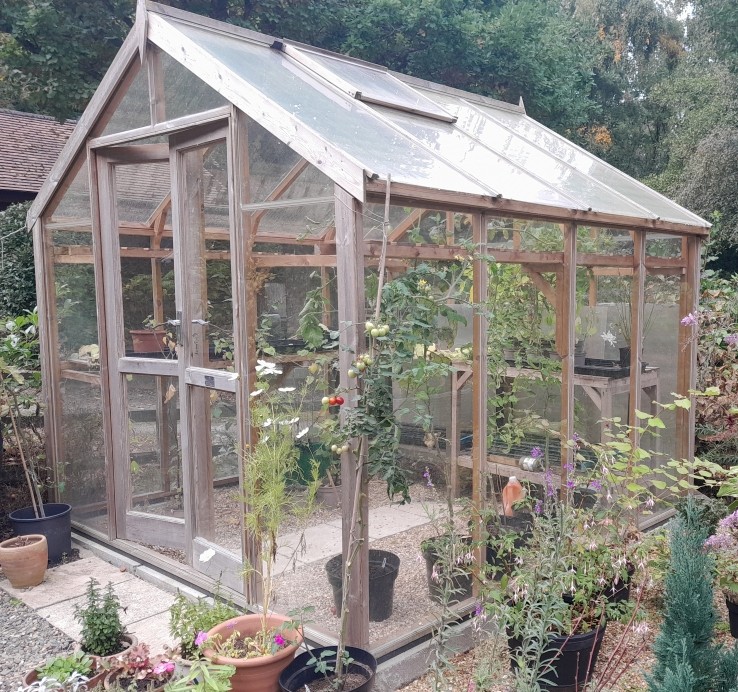
Choosing and Siting Your Greenhouse
Types of Greenhouse
- Greenhouses come in a range of shapes, sizes, frame and glazing materials.
- Round greenhoues can be ueful for windy sites.
- Lean-to’s tend to be warmer.
- Coldframes are very useful additions, especially to a small greenhouse.
- Polytunnels can be used to grow almost any fruit and vegetables, thereby extending the growing season. However, polythene has a life of about 5 years before it needs replacing and there is an environmental issue in dealing with waste polythene.
Location
An East-West ridge orientation is best for light, especially in spring and autumn.
If you can’t manage the optimum orientation, try to make sure the south side of the greenhouse gets full sun and avoid siting where the east, west and south sides are in a lot of shade.
Base
The base must be level across the width of the greenhouse with a gentle fall along the length for good drainage.
Don’t forget to anchor the structure securely!
RHS – Choosing the Right Greenhouse
The Greenhouse Effect
Temperature
Small greenhouses warm up quicker. A max-min thermometer is essential to help manage the temperature in summer (see Air Circulation).
In spring use heated propagators or heat mats to provide enough warmth for germination.
Humidity
Higher humidity is good for propagation and fruit but bad for disease and fungal problems, particularly when combined with stagnant air (see Air Circulation).
In summer, damp down all surfaces to increase humidity.
Air Circulation
Ideally aim for a gentle flow of air through the greenhouse. This can be achieved with louvres fitted lower down on the sides and vents fitted in the roof. This arrangement creates a chimney effect.
Avoid opening the doors for air circulation in spring and autumn because this will introduce too much cool air.
Light
Keep the greenhouse panes clean to maximise light through most of the year (this also helps reduce fungal disease).
In Summer you may need to use shading to avoid scorching tender leaves and to help control the temperature:
- Paint is the easiest option – it resists rain and has to be rubbed off in autumn.
- Internal blinds still allow warm air into the greenhouse so external blinds are better for temperature control.
- External blinds don’t need to be expensive – e.g., a DIY version can be made with old net curtains fixed to bamboo poles.
Watering
Tap water is fine for most applications.
Rain water is preferable in some cases (and to reduce tap water use). Multiple rain water butts would be needed to supply a greenhouse all year round. Water butts must be cleaned out at least once per year and used with a tight fitting lid to avoid the water containing fungal spores.
Invest in a good quality watering can with a long spout to allow plants at the back of a bench to be watered without damaging the ones at the front. A fine rose will be needed for watering seed trays and seedlings.
A drip system is recommended for greenhouse beds.
Greenhouse Beds
If you want to use beds rather than pots, raise the soil about 6” above the greenhouse floor and support the edges with boards.
Check the soil pH and lime if necessary in autumn.
In autumn (or spring if liming has been done) add a 3″ layer of good quality compost to refresh the beds after the years harvest.
Greenhouse Pests
Check regularly for pests:
- Bio controls work in warm summer months.
- Sticky traps are useful year round for flying insects.
- SB Plant Invigorator is recommended as a contact insecticide and fungicide. It will need repeat dosing.
SPRING
Your greenhouse can be used to get the growing year off to an early start, but monitor conditions rather than relying on a calendar date. A soil thermometer is useful – most seeds will germinate at 15-20°C (seeds needing a higher temperature and an early start may be better indoors). Only sow seeds when the temperature is 9°C and rising.
Growing Media
- Peat-free compost can be variable and, in general, cheaper products give poorer results. £8-10 is typical for a bag of good quality compost for sowing and growing on.
- Buy specialist seed compost or invest in a seed sieve to get a fine compost and mix with perlite.
- Allow wide spaces between rows or within pots to allow as much light as possible to reach seedlings.
Seed Sowing
- Prepare seed trays well (they should have been cleaned thoroughly at the end of the previous season).
- Overfill with compost and strike off the excess.
- Make sure the compost is moist before you sow by watering with a fine rose (or you can place the tray in a bowl of water until damp).
- Level the surface lightly.
- Transfer the seed to your hand – it’s much easier to control the sowing from your hand than from a packet.
- Cover the seed with vermiculite or compost.
Pricking Out
- Prick out at the cotyledon stage (i.e., when the seed leaves have formed but before the true leaves form). This is particularly important if you are using a specialist seed compost that will contain few nutrients.
- Handle the seedling by a leaf, not the stalk, and place into a large hole.
- Collapse the soil around the seedling roots.
- Leggy seedlings should be planted deeply.
Also consider buying seedlings online or from garden centres, although you won’t have as much choice if you do this.
Spring Crops to Grow
| Salad Leaves | Sow small amounts regularly: 35-40 days to harvest in late winter/early spring |
| Cut & Come Again Salad | Should provide 2 or 3 cuttings |
| Radishes | Round varieties are best for early spring sowing: space sow 1” apart |
| Pea Shoots | |
| Baby Spinach | |
| Water Cress | Sow in very damp compost |
| Carrots | First sowing can be done in mid February |
| French Beans | From early March |
| Mangetout | From early March |
SUMMER
Greenhouse Fertilisers
The main summer crops for the greenhouse include tomatoes, cucmbers, peppers and aubergines: all need lots of feed to keep them healthy and maximise crops:
- Organic feeds tend to be gentler than the alternatives.
- Seaweed-based fertilisers are ideal (e.g., Maxicrop that acts as a bio-stimulant and feed).
- Phostrogen organic all purpose liquid feed is also recommended.
RHS fertiliser recommendations
Tomatoes
Tomato Varieties to Try
- Shirley.
- Alicante.
- Sweet 100 Cherry.
- Beefsteak.
Grafted plants are also worth considering and will tend to produce healthier and higher yielding plants.
Tomato Problems
- Scorched leaves – see shading.
- Dry set causing stunted tomatoes – increase air circulation.
- Sun scorched – see shading.
- Splitting and Blossom End Rot caused by inconsistent watering – avoid overly dry soil or watering too much onto dry soil.
- Yellowing leaves may be due to a magnesium deficiency and can be treated with Epsom salts.
Cucumbers
- Mini Munch, Cucino and Femspot are recommended varieties.
- Germinate somewhere very warm (25-27°C is needed).
- Seedlings should have 4 true leaves before planting out.
- Top up with compost to cover any roots that start showing on top of the soil.
Cucumber Problems
Powdery Mildew is caused by a fungal disease – improve air circulation.
Peppers
Sweet Pepper recommended varieties: New Ace, Mohawk (limited yield).
Chilli Peppers:
- Choose a compact variety like Apache.
- Use a restricted pot with a cane for support.
- These are perennial plants so you can try to keep them for next year if you have somewhere warm to grow them.
Aubergines
Grow like peppers, but they can be very vigorous so provide support.
MID-LATE SUMMER
Summer greenhouse crops continue into autumn.
Propagate tender perennials from cuttings:
- Pelargoniums
- Penstemon
- Salvia
- Fuschia.
Pot up bulbs for winter displays – they need a period of cold (9°C and below) for 13 weeks before flowering.
AUTUMN
Autumn is a good time to empty the greenhouse and give it a good clean.
- Scrub with a detergent like Ecover – make sure to get into all the nooks and crannies.
- Rinse with a garden hose (not too much pressure to avoid damaging panes).
- Give the glass a clean to maximise winter sunshine.
If you have borders in the greenhouse autumn is a good time to add lime or compost to the soil.
Sow winter salads by the end of September for use over late autumn and winter:
- Mustards.
- Kale.
- Corn salad.
- Rocket.
Bring some pots of hardy herbs into the greenhouse to keep them clean and edible over winter.
WINTER
You can use bubble wrap to protect winter crops in the greenhouse, but avoid putting this on the roof. It’s better to bubble wrap individual pots or trays or cover with fleece during very cold spells. Good air circulation remains essential.