
Monday’s meeting involved a presentation by Ben Matthews on hostas. Ben talked of his first awareness of hostas, when, as a six-year-old, his parents bought home two hostas for their new garden. Over the next few years Ben learned about planting and growing from the lessons to be observed, and by his early teenage years had increased his hosta plant holdings to about a dozen. Now, from his property in Worcester, he holds the National Collection of Hostas, watching over some 600 different registered names. He is always looking out for names he does not have in the collection, and also hybridizing and propagating new varieties for registration.
Ben gave us the history of hosta introduction to the wider world. Hostas had first been identified in the East – Japan, China, Korea – around the 1400s, when these countries began to be opened up by adventurer travellers, traders, missionaries and diplomats. The plants were prolific, growing anywhere where there was a little soil and some water, and they were predominantly green. The name of Hosta is believed to come from a plant collector called Host, and the name was used by M. Siebold, of sieboldiana, and Robert Fortune of fortuneii fame.
By the 1900s, the number of varieties was about 60, growing quickly to 80. Today, the American Society of Hostas numbers 7,384 registered varieties. To achieve registration, the new plants have to be tested under a rigid system of molecular and visual parameters to achieve formal approval for entry onto the register. The American system is much more stringent than our own.
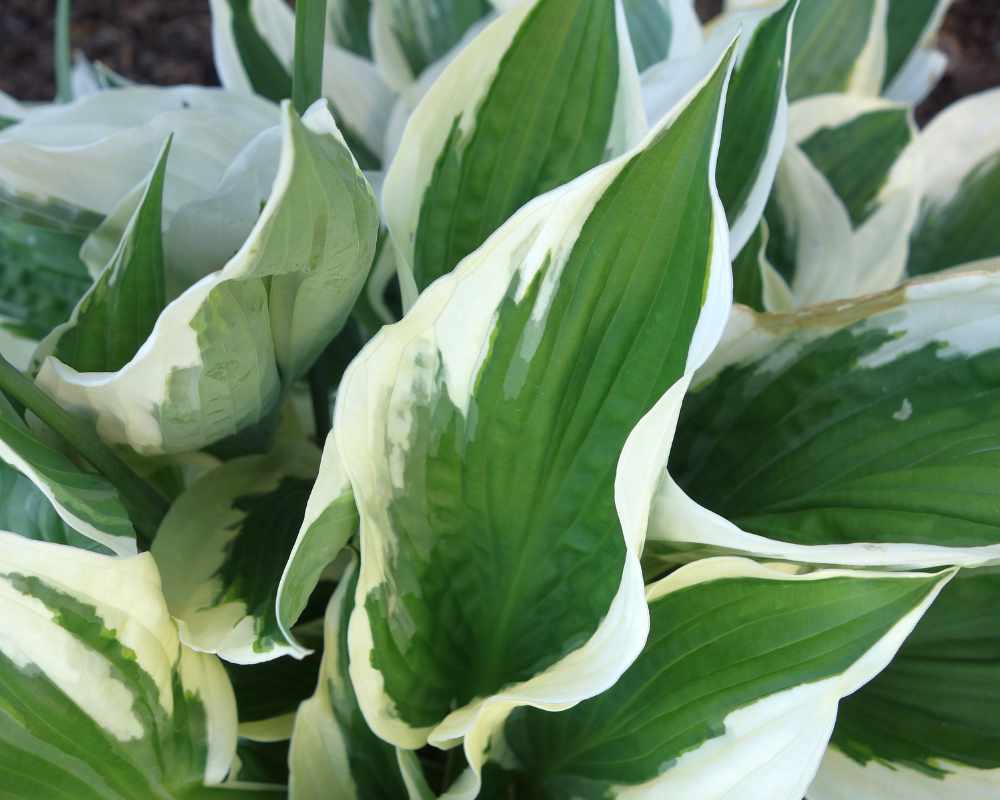
But who wants a garden full of green hosta? Hostas have achieved their place in our plant collecting because of the varieties of shape, size, flowers and fragrance, but mainly because of the tremendous range of variations of colours and shapes in the leaves – white, yellow, gold, lime, and glauca blue – and how those colours appear – stripes on outer edges, streaks and flashes. The latest work is on a red version but its staying power is limited; the white version is very susceptible to sunburn. Hostas carry out their own form of hybridization in the form of spore production and therefore it is useful to observe your own plants to see if a new variety has been created.
Ben brought us back to earth by mentioning pests and diseases, and then listed a few defence mechanisms: coffee grounds, eggshells, sharp gravel and anything to make travel uncomfortable for a snail or a slug; a garlic spray to make the leaves inedible; and then the torch and bucket job on a warm damp evening. For my own plants, I liberally use a standard pest control spray. All these methods have a measure of success, but they have to be used and maintained regularly.
Ben’s National Collection is open by arrangement. Cleobury Gardeners are hoping to organise a visit. If you are interested in joining us, please make contact and we will keep you informed of feasibility, date and charge.